
A. Differential slipping and “spikes”
One thing missing from the simulation models used so far is the influence of the finite width of the ribbon of bow-hair — the models have all assumed a single point of contact between bow and string. The most obvious effect of finite width is best introduced by an example. Listen to Sound 1: this is a recording using a bridge-force sensor on the open G string of a violin. The player gradually slides the bow towards the bridge, getting very close at the end of the sample. In the sound, you should be able to hear a growth in harshness of the sound, ending with a definite “crunch”. This example is intentionally extreme, but players sometimes make deliberate use of this harsh sound at moderate level.
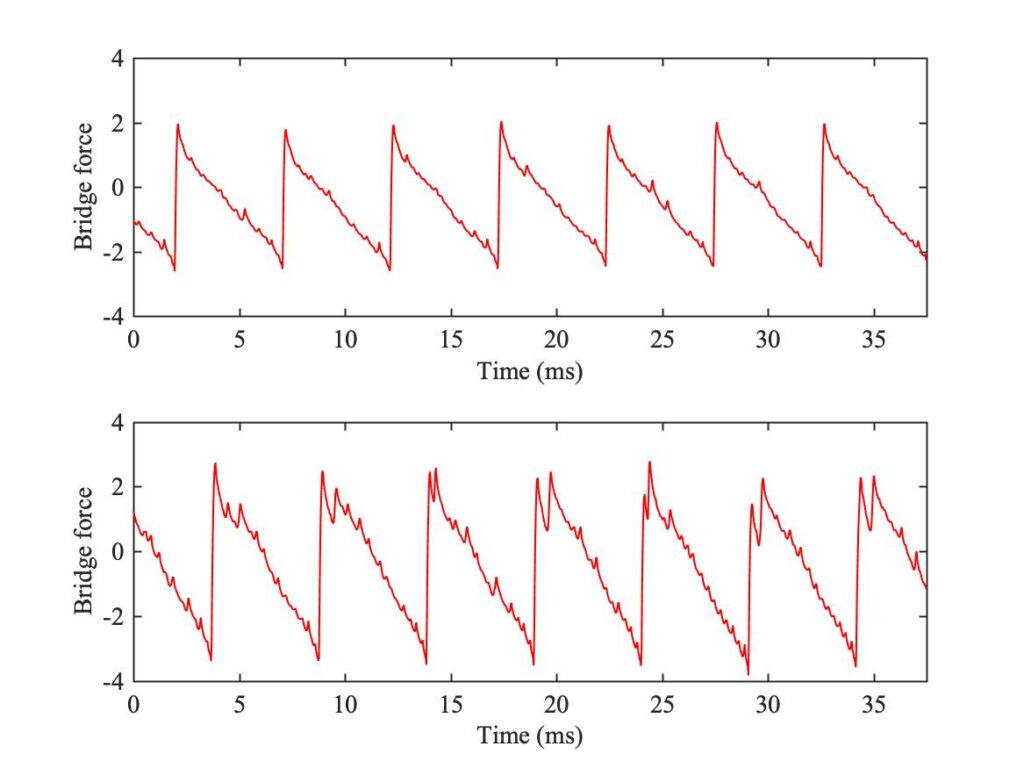
Figure 1 shows two extracts from this measured waveform, from early and late in the sequence. Both show the familiar Helmholtz sawtooth waveform, but they both have something extra superimposed. The upper trace shown occasional small spikes in the waveform, which differ in detailed placement from cycle to cycle. The lower trace shows a similar thing in more extreme form: it is not surprising that this irregular waveform might sound harsh or noisy.
We get a clue about what might be happening from Fig. 2. The upper diagram shows the moment in an ideal Helmholtz motion when the travelling corner has just gone past the bow, setting off towards the player’s finger. The ribbon of bow-hair is indicated by the yellow stripe: deliberately shown very wide, to make the effect clear. The lower diagram shows what might happen later in the cycle, shortly before the Helmholtz corner gets back to the bow. In the ideal version of Helmholtz motion, the string shape would follow the dotted line. But if the portion of string in contact with the bow has been sticking throughout this time, over the entire width of the bow-hair, the string would need to take up a zig-zag shape more like the solid line.
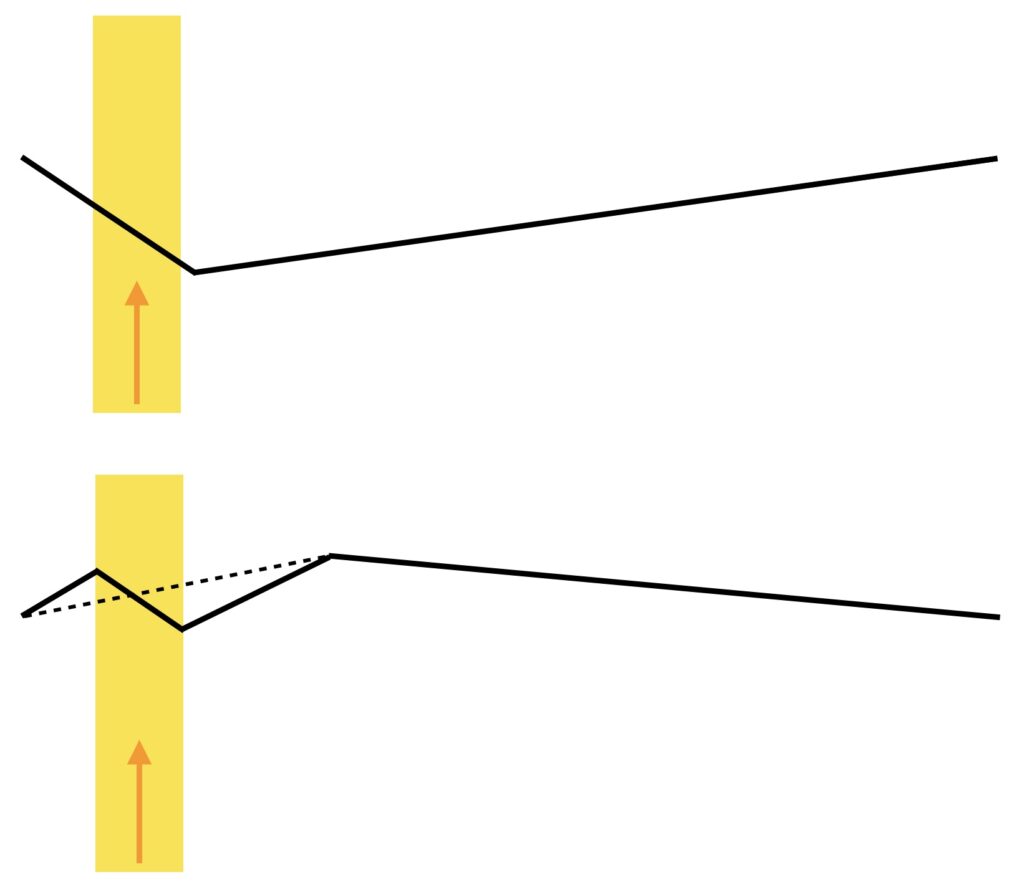
There are sharp corners at the edges of the bow-hair. These produce concentrated forces, in opposite directions on the two edges. This feels physically unrealistic: surely we might expect the string to have slipped in some region near the edges of the bow, before things got this extreme? Those localised slips, at the edge of the bow facing towards the bridge, are responsible for the “spikes” we saw in the bridge-force waveforms of Fig. 1. The effect becomes more extreme when the bow moves closer to the bridge.
We can confirm this idea by extending the computer simulation model to allow for a bow of finite width. Finite-width bowing has been most thoroughly investigated by Roland Pitteroff [1,2]. He included effects such as the elasticity of the bow-hairs, but unfortunately the approach he used cannot readily be combined with the simulation model we have used earlier (developed by Hossein Mansour [3]), for reasons of numerical stability. So instead, we use a simpler model which harks back to the earliest work on this topic [4], around 1980. It assumes a rigid bow, but one which contacts the string at several points rather than a single point. This model will allow us to make direct comparisons with the earlier simulations and the Galluzzo measurements, both based on bowing a cello D string. Some details are given the next link: the model is a straightforward extension of the point-bow model used earlier, so we can make direct use of the same friction models introduced in section 9.6.
Figure 3 shows one example of such a simulation, using 6 “bow-hairs”. This particular example was made using the enhanced thermal friction model, initialised with ideal Helmholtz motion and then allowed to run for a while for the motion to settle down. The bridge force waveform shows an irregular pattern of spikes superimposed on a more-or-less steady Helmholtz sawtooth, qualitatively similar to the results in Fig. 1.

Figure 4 shows the corresponding pattern of sticking and slipping across the width of the bow. The time axis matches Fig. 3, and the top edge of the plot corresponds to the edge of the bow closest to the bridge. Black pixels indicate sticking and white ones indicate slipping. The main Helmholtz slips show up as top-to-bottom white stripes, while the partial slips causing the spikes in Fig. 3 show up as white streaks in the upper part of the plot. There is just one red pixel in this example, indicating slipping in the reverse direction: it occurs at the bottom edge of the plot, as Fig. 2 might have led us to expect.

B. The effect on Schelleng’s diagram
The same computational approach can be used to explore the effect of finite bow width on the behaviour in the Schelleng diagram. Simulations initialised with ideal Helmholtz motion can be made at a grid of points in the Schelleng plane, with different values of bow force and bow position distributed on logarithmic scales to match the Galluzzo measurement. The result of that measurement was discussed back in section 9.3, and the main plot is reproduced here as Fig. 5 (with the addition of some markup in green and blue, to be explained shortly).

The measurements were made with the rosin-coated rod — unlike the Guettler measurements, they were not repeated using a normal cello bow. This means that direct comparisons with simulations will need to be with a point-bow model, but we can then use the finite-width simulations to indicate how things might change with a real bow. Figure 6 shows a Schelleng diagram simulated using a single-point bow and the enhanced thermal model of friction. The bow speed was 50 mm/s, as in the experimental measurements. Figure 7 shows the corresponding plot using 6 “bow-hairs” spaced over the 10 mm width of a cello bow, centred in each case on a nominal position indexed by the value of $\beta$.


It is probably useful to start with a reminder of what we expect the Schelleng diagram to show, and what the different colours signify in these plots. All three plots show a central region of red pixels, connoting Helmholtz motion. Below the red pixels is a band of orange colour, connoting “double-slipping motion”, often described by players as “surface sound”. Below these orange pixels are some yellow ones, indicating a region where long-lasting steady stick-slip motion seems not to be possible at all — the string motion simply dies away.
On the opposite side of the region of red pixels, in the top right corner of all three plots, some black pixels can be seen. These connote non-periodic motion, described by Schelleng as “raucous”. Finally, there are some white pixels. These connote approximately periodic motion that is neither Helmholtz motion nor double slipping. We will see some examples shortly — they are all what Raman described as “higher types” of string motion, and are something players usually try to avoid unless they are deliberately seeking an unusual tone colour. (Some examples were shown in section 9.1.)
Schelleng predicted that the upper limit of Helmholtz motion, the maximum bow force, should follow a straight line in these log-log plots, with a slope of $-1$. The lower limit, the minimum bow force, should also follow a straight line, but with a steeper slope with the value $-2$. The two green lines marked in all three plots show what these slopes look like. The specific lines were fitted to the simulated results in Fig. 6, then the same lines were included in the other two plots.
We can learn some interesting things from these lines. First, it is by no means obvious that Schelleng’s argument will really apply to our thermal friction model, and even less obvious that it will apply to the finite-width simulations. But in fact Figs. 6 and 7 both show the red-black boundary following the upper green line very well, and the red-orange boundary tracking the slope of lower green line quite closely. It looks as if the pattern of Schelleng’s limits continues to apply, and that a finite-width bow makes rather little difference to this aspect of behaviour except that the minimum bow force seems to have reduced a little in this example.
The regions of white pixels cut across the upper green line in Figs. 5 and 6, but that is not unexpected. Versions of Schelleng’s calculation can be constructed for the various “higher types”, and this is the predicted behaviour: each variety of “higher type” has its own maximum and minimum bow force, different from those for Helmholtz motion. Note that the white pixels encroach into the red region much less in Fig. 7: we will return that observation later.
Comparing Fig. 5 with Fig. 6, we can see some strong similarities but also some differences. The red-orange boundary follows a similar trend to the green line, but it is displaced upwards in Fig. 5. The precise shape of the red-black boundary cannot be seen very clearly, but it seems to be a little higher than the green line deduced from the simulations. Another obvious difference between Figs. 5 and 6 is in the number and positions of the white pixels. The two plots show a generic similarity, although the details do not exactly match. Both show vertical columns of white, at high values of $\beta$. To see what lies behind all these differences, we need to look at some waveforms in detail. Three columns have been chosen, marked by blue rectangles in all three plots. Matching extracts of bridge-force waveforms for every second pixel in these columns are plotted in Figs. 8—10. In each plot the measured set is on the left, the single-point simulations in the middle, and the finite-width simulations on the right.


Figure 8 shows results for a bowing position fairly close to the bridge. All three stacks of waveforms show the expected transition from Helmholtz motion at high force to double-slipping motion as the force reduces. For the measured set (on the left), we can also see a further transition to motion without any sharp corners, which seems to be simply dying away, as mentioned above. There is no corresponding transition visible in the simulated examples, they continue to show a double sawtooth form all the way to the bottom. As was already clear in Figs. 5–7, the position of the transition marking the minimum bow force is higher in the measurement than in either simulation. If you look closely at the top waveform in the right-hand stack, you can see some “spikes” connoting differential slipping as seen in Fig. 3.
Figures 9 and 10 show waveforms in two adjacent columns of the Schelleng diagram, in a region where white pixels appear. Both figures show Helmholtz motion at the bottom of every stack, but what happens higher up varies from case to case. One thing that is highlighted by this plot is that the maximum bow force boundary is sometimes quite ill-defined: there is a gradual progression from something that looks like a Helmholtz sawtooth, through a blurred state, then emerging as something that definitely looks like a “higher type” such as S-motion. Look at the left-hand stack in Fig. 9, for example: where is “the” position of maximum bow force here? The corresponding colour change in Fig. 5 is thus a bit misleading: a choice has been made about whereabouts in this gradual transition to choose, whereas to represent the actual results, the colours should gradually fade from red to orange.
But in other cases, things are more clear. The left-hand stack in Fig. 10 shows an abrupt transition between the 4th and 5th waveforms (counting from the bottom). Interestingly, this transition is not mirrored very convincingly by the simulations in the middle stack of that figure — but it is mirrored in the middle stack of Fig. 9, where a transition to a very similar-looking higher type occurs. The conclusion from these plots is that the measurement shows a pattern of white pixels that is qualitatively similar to the single-point simulations. The precise position of the vertical columns is different in the two cases, but Figs. 9 and 10 suggest that much the same repertoire of higher types is seen in both cases. With such a rich array of possible string motions, it is perhaps not surprising that there are detailed differences between measurement and simulation in terms of which regime occurs where.
The finite-width simulation (Fig. 7) shows fewer white pixels, and thus a Helmholtz region in the Schelleng diagram which is more orderly and closer to Schelleng’s original prediction. Somehow, the finite width is having some kind of filtering effect that tends to suppress higher types, which all involve large oscillations at the same frequency as the Schelleng ripples. The effect can be seen in more detail by comparing the central and right-hand stacks in Figs. 9 and 10. Probably, players would welcome this difference. They are less likely to stray into unwanted S-motion or other higher types. Perhaps this is one reason for the use of a conventional bow, although there are many other reasons, some of them to be explored in the subsequent discussion.
There is another interesting thing to be learned from these simulations of the Schelleng diagram. Back in section 9.2, we saw a discussion of the effect whereby hysteresis in the friction behaviour during a cycle of Helmholtz motion can lead to pitch flattening of the note, especially when the bow force is high. The argument presented there was firmly based on the friction-curve model and a single bowing point, so it is interesting to explore whether the flattening effect is still predicted by a simulation model using the thermal friction model, and with a bow of finite width.
All the cases leading to red pixels in Fig. 7 were analysed in an attempt to extract the frequency of the Helmholtz motion. This was done by looking for the zero-crossings of the “Helmholtz flyback” in the bridge force over the final few period-lengths of each simulation. For cases identified clearly by the automated procedure, the averaged time interval between those zero-crossings was used to calculate a frequency, which was normalised by the nominal frequency of the fundamental resonance frequency of the string, 146.83 Hz. The results, expressed as a flattening in cents, are plotted in Fig. 11. The “floor” at $-10$ cents marks non-Helmholtz points.

The results show a very interesting pattern. Nearly all the lines show a steady rise as bow force increases. This is the “flattening effect” in action, more or less as the original argument suggested. But that argument does not predict the other obvious feature of the pattern: the plot reveals a remarkable sensitivity to the value of $\beta$, with the degree of flattening rising and falling in an apparently irregular way.
Notice that at the lower values of bow force, each line begins from a level with negative “flattening”. In other words, the note plays a little sharp relative to the frequency of the fundamental string resonance. This is probably caused by the influence of bending stiffness. Helmholtz motion always involves a significant contribution from higher overtones in the string motion, and in the free string those higher overtones are systematically sharp compared to a harmonic series based on the fundamental. The bowed string then chooses a “compromise pitch” that is slightly sharp, as these results show.
It is worth seeing some details for a typical example. The green circle in Fig. 11 marks a case showing significant flattening. Figure 12 shows the final bridge force waveform for this case, plus corresponding maps of the slip/stick state and the temperature distribution across the width of the bow. The temperature reaches a maximum of 27$^\circ$ above ambient, or 47$^\circ$C. Figure 13 shows a plot of the friction force (normalised by the normal force on each “hair”) against velocity. A separate line is plotted for each “hair”, but they all lie on approximately the same path. A hysteresis loop is seen, qualitatively similar to the one shown in Fig. 6 of section 7.6.


C. Tilting the bow
The finite-width bowing model allows us to make a preliminary exploration of something important. We have already discussed the effects of several variables a player can control during bowing: the bow force, speed and acceleration, and the position of the bow on the string. But there is another important variable, which we have ignored up to now: players do not necessarily press the bow-hair flat against string. Instead they usually tilt the bow, so that the distribution of normal force is not uniform across the width. The degree of tilt often varies in the course of each bow stroke, and in extreme cases it may be so large that the hairs only contact the string over a small part of the width. Manipulating bow tilt is a major ingredient of the player’s armoury, when striving to achieve subtleties of tone.
We will not attempt to model such subtleties here: instead, we will explore some of the simpler effects of bow tilt by comparing three idealised cases. The bow width in contact with the string will stay the same, but three different distributions of normal force will be used: uniform (the “flat bow”), or tapering linearly across the bow from near zero at one edge to a maximum at the other edge. This taper could go in either direction. Conventional tilt involves reducing the force on the side facing the bridge, and players do not ordinarily tilt in the opposite direction, so we will label these two cases “correct tilt” and “incorrect tilt”.
Figures 14, 15 and 16 give a first impression of the consequence of a tilted bow. Figure 14 repeats the plots from Figs. 3 and 4, with a flat bow. It shows Helmholtz motion, with some irregular “spikes” in evidence. Figure 15 shows the “correct tilt” case: all parameters are the same, except that the normal bow force varies linearly across the width of the bow, falling to zero at the edge nearest to the bridge and rising to double the mean level at the opposite edge. Figure 16 shows the converse case, with “incorrect” tilting so that the force is higher at the edge nearest to the bridge.


Comparing Figs. 14, 15 and 16, the bridge force waveforms look quite similar but the stick-slip patterns are significantly different. With the flat bow, the white streaks marking the partial slips responsible for the obvious spikes in the bridge force extend across almost the whole width of the bow. For the correctly tilted case the same is true, but now the edge of the bow nearest to the bridge is slipping for far more of the time. For the incorrectly tilted case, the converse pattern is seen. The section of the bow facing the bridge is sticking most of the time, while the other edge is usually slipping, mostly in the reverse direction indicated by red points in the plot.
Figures 17, 18 and 19 explore the consequences of bow tilt for Schelleng’s diagram. Figure 17 shows a repeat of Fig. 7, for the flat bow; Fig. 18 shows the case with correct tilt; and Fig. 19 shows the case with incorrect tilt. The most conspicuous difference between these three plots is that the red-orange boundary and the red-black boundary have both shifted: downwards in Fig. 18 and upwards in Fig. 19. These shifts are due in part to a change in the “centre of gravity” of the normal force, from the centre of the bow-hair in the flat case towards one edge or the other in the tilted cases. To indicate the consequences of this shift, the green lines have been augmented by dashed lines indicating where Schelleng’s argument predicts they would appear for a single-point contact at the two extreme edges of the bow (but with the $\beta$ value on the horizontal axis still at the bow centre because the player hasn’t shifted the bow, they have only tilted it).


The shift in minimum bow force (red-orange boundary) is quite well captured by the difference between dashed and solid green lines. The shift in boundary for the case with correct tilt is indicated by the offset of the lower dashed line, while for the case with incorrect tilt it is indicated by the offset of the upper line, very much as one would have guessed from the lower plots in Figs. 15 and 16. Correct tilt tends to increase the effective value of $\beta$, while incorrect tilt would tend to decrease it. The reduction in minimum bow force associated with correct tilting may point to one reason a player might use such tilting, if they want to play quietly.
The situation is less clear for the red-black boundary and the maximum bow force. Tilting in either direction makes relatively little difference to this limit, and the dashed green lines mark out a narrower band in the plot. However, there is another obvious difference between the Schelleng diagrams. Correct tilt leads to more white pixels, so using a tilted bow while playing far from the bridge makes it a little more likely that a higher type such as S-motion will be obtained, rather than Helmholtz motion. The conclusion is that a player wanting to play far from the bridge and use high bow force (while maintaining Helmholtz motion) would probably do best with a flat bow.
D. The effect on Guettler’s diagram
Having looked at the effects of finite width and tilt on the steady motion of a bowed string, we can now turn to transients and the Guettler diagram. Section 9.6.3 gave some detailed results comparing measurements with point-bow simulations, using the original and enhanced thermal models for friction. There are good reasons to expect the enhanced model to be closer to reality, but that section highlighted two areas where the original thermal model seemed to give better predictions than the enhanced model. The effects were shown most clearly at the largest value of $\beta$ from the measurements, so to see how these issues are impacted by finite bow width we will concentrate on this case with $\beta = 0.18$.
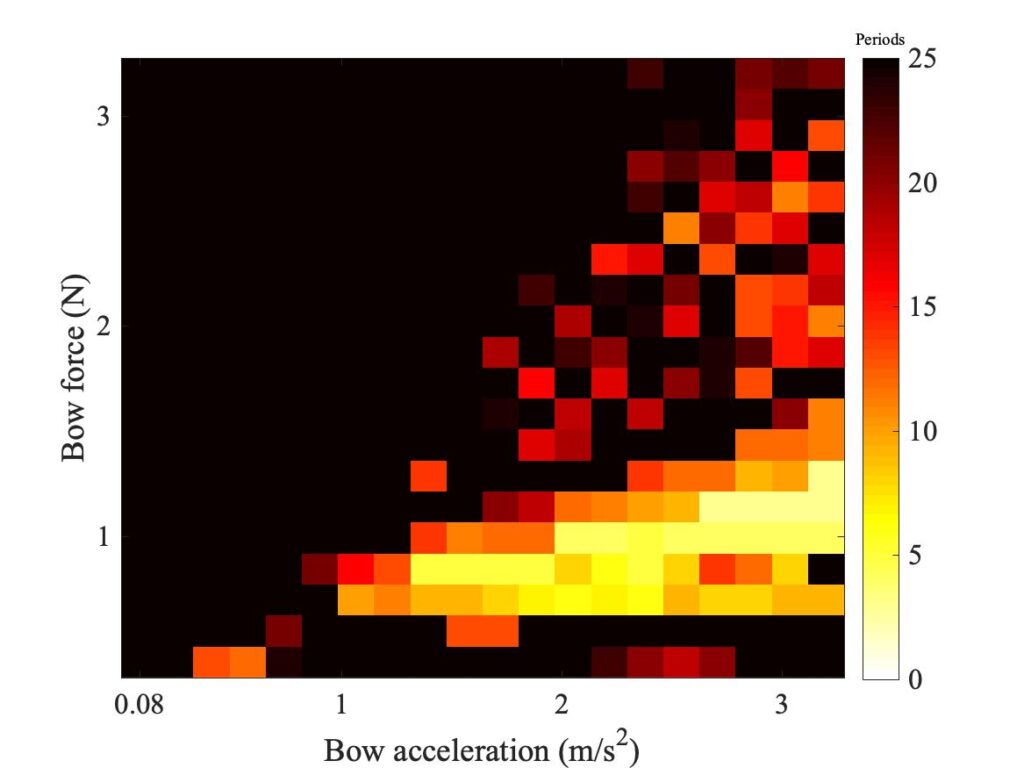
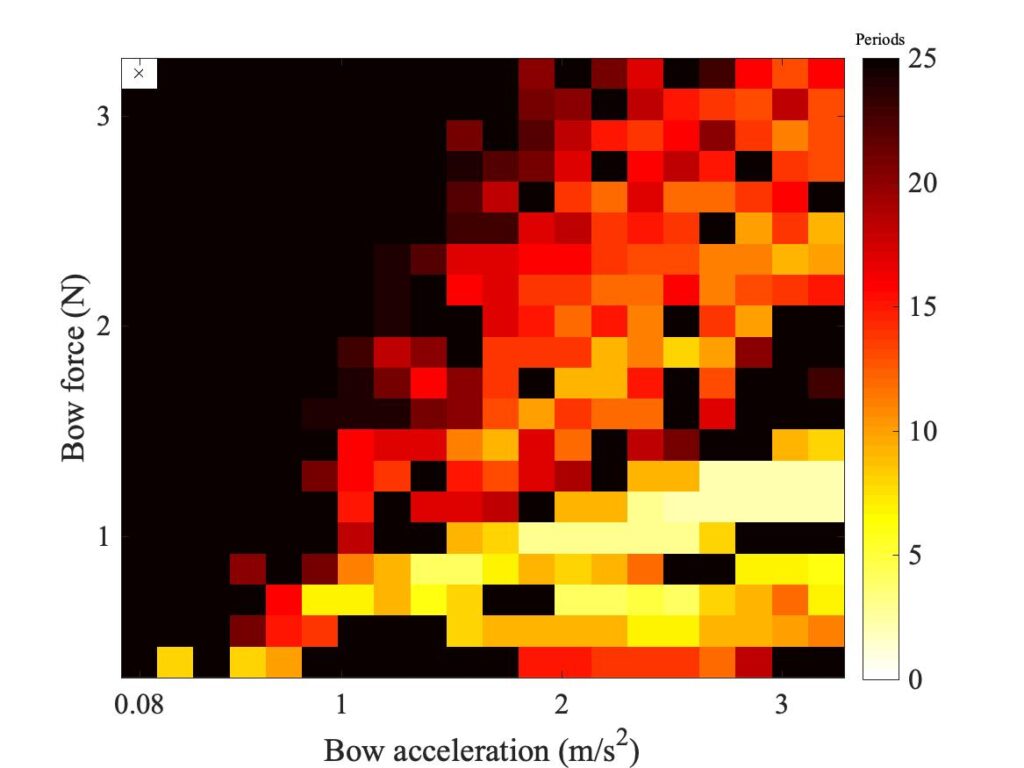
Figure 20 shows the relevant measurement, while Fig. 21 shows the corresponding simulated result using the point-bow model with the enhanced thermal friction model. Figure 22 shows a direct comparison using the finite-width model, with a flat bow. One of the two issues pointed out earlier is immediately obvious from the comparison of Figs. 20 and 21: there is far more “black space” in the upper left of Fig. 21. Figure 22 shows that the finite-width model has gone some way towards filling this in with coloured pixels. The colours in Fig. 22 are generally less bright than in Fig. 20, connoting somewhat longer transients, but the total area covered by coloured pixels is significantly closer to the measured case than was the case with Fig. 21.
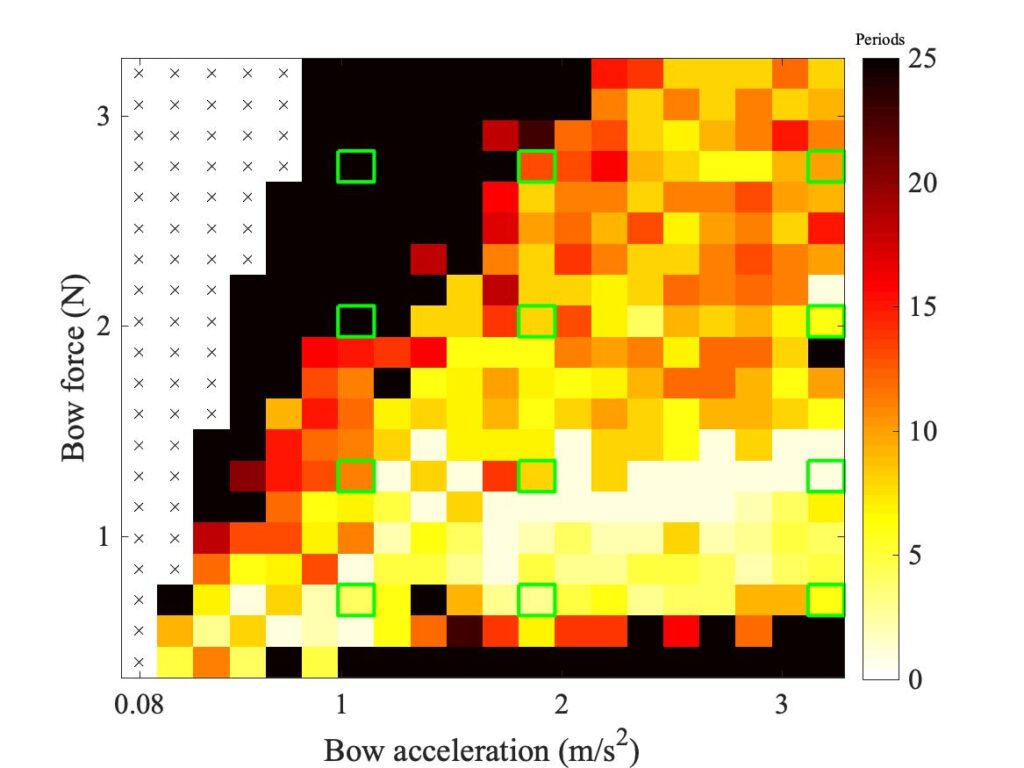
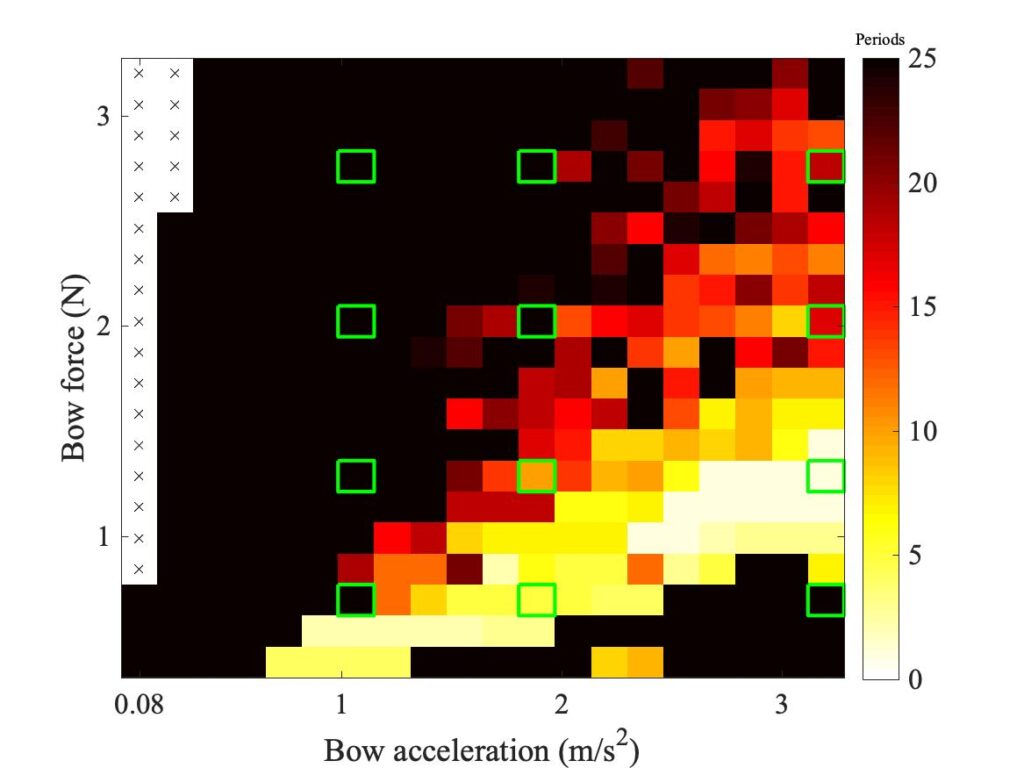
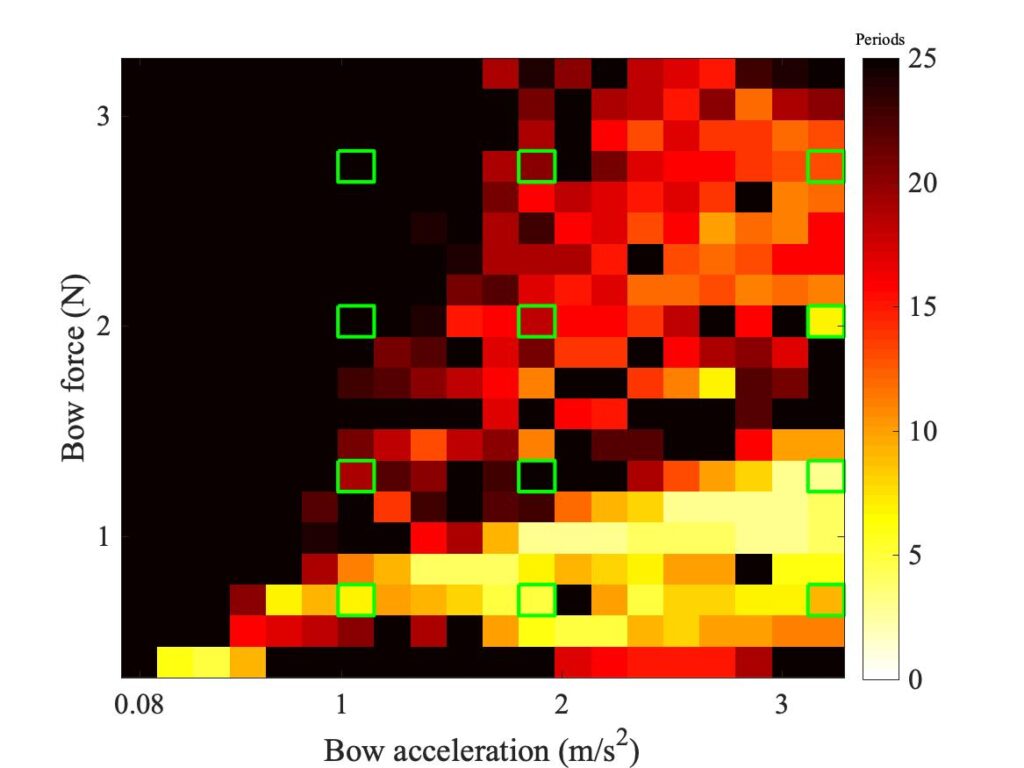
This is encouraging, but there is more good news when we dig into the waveforms lying behind these Guettler plots. Figures 20, 21 and 22 are all annotated with green squares, marking cases we will look at in detail. Figures 23, 24 and 25 then show comparisons of bridge-force waveforms for these cases, one column at a time. Specifically, they show a short extract towards the end of the measured interval, which was 0.25 s long. In each figure, the left-hand panel shows the comparison of the measurements (in black) with the simulations using the point-bow model (in red). The right-hand panel shows the corresponding comparison with the finite-width simulations. To aid comparison, all waveforms have been scaled to the same RMS value and the simulations have been phase-shifted if necessary to bring them into a best match with the measurement.
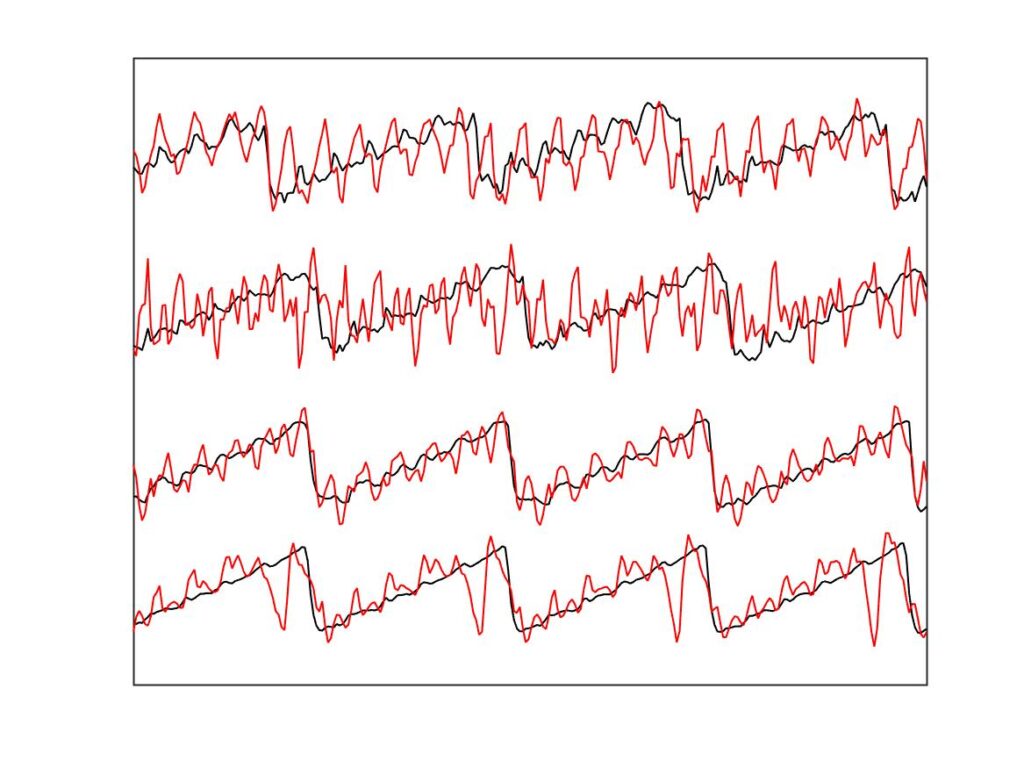
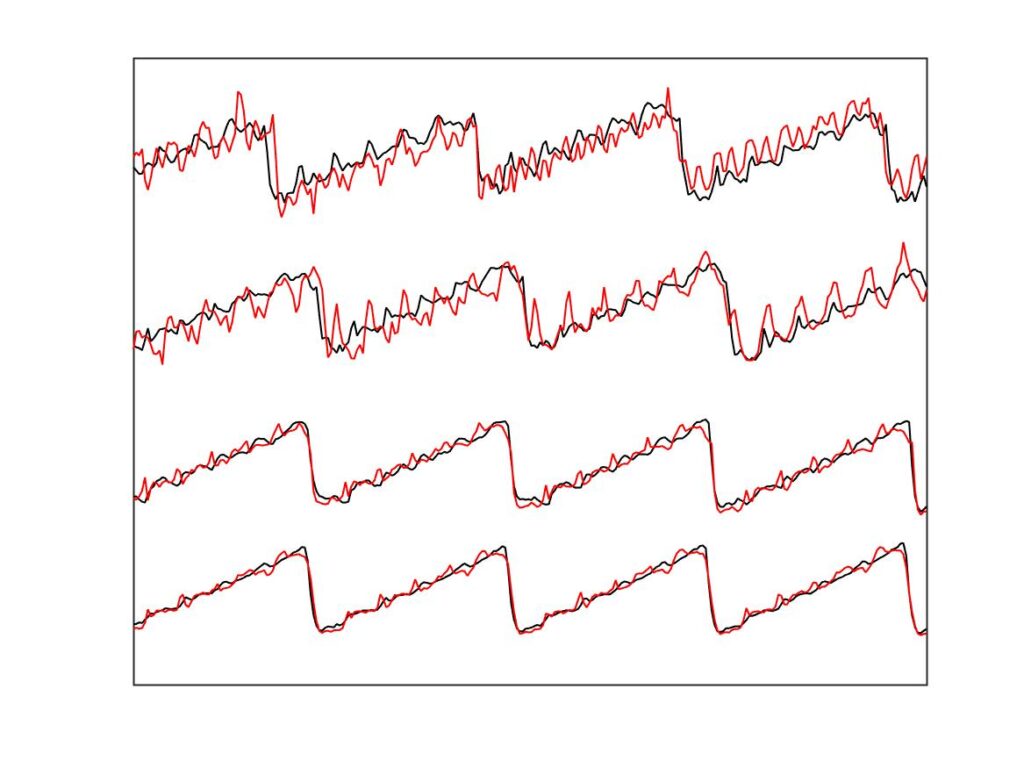
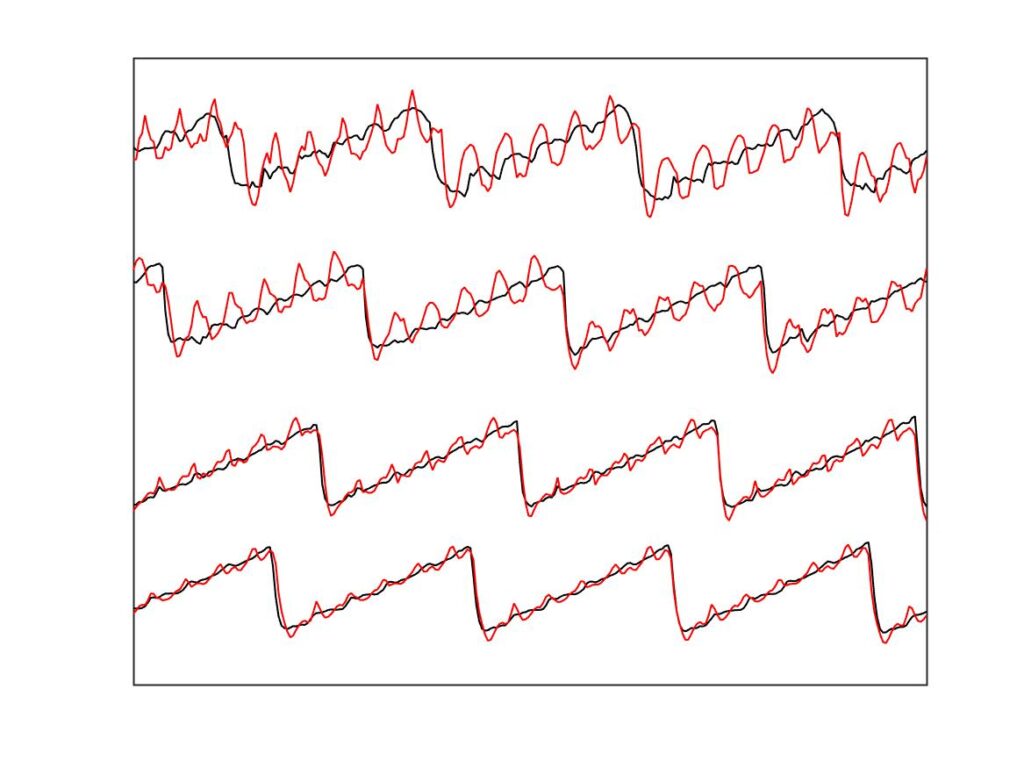
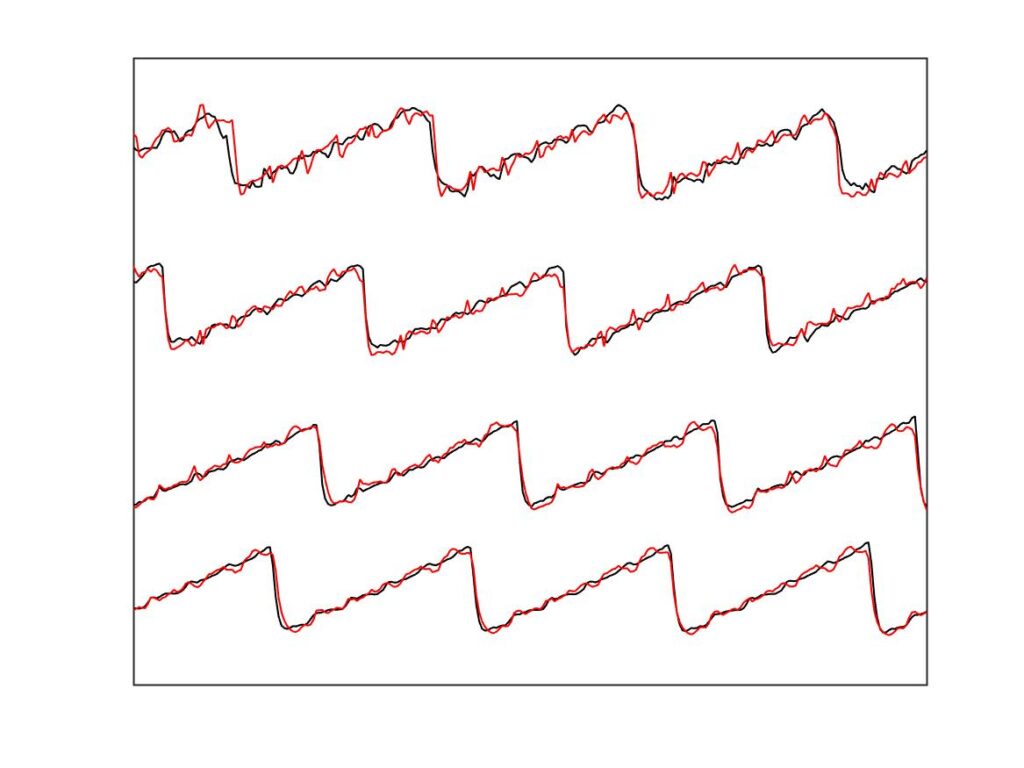
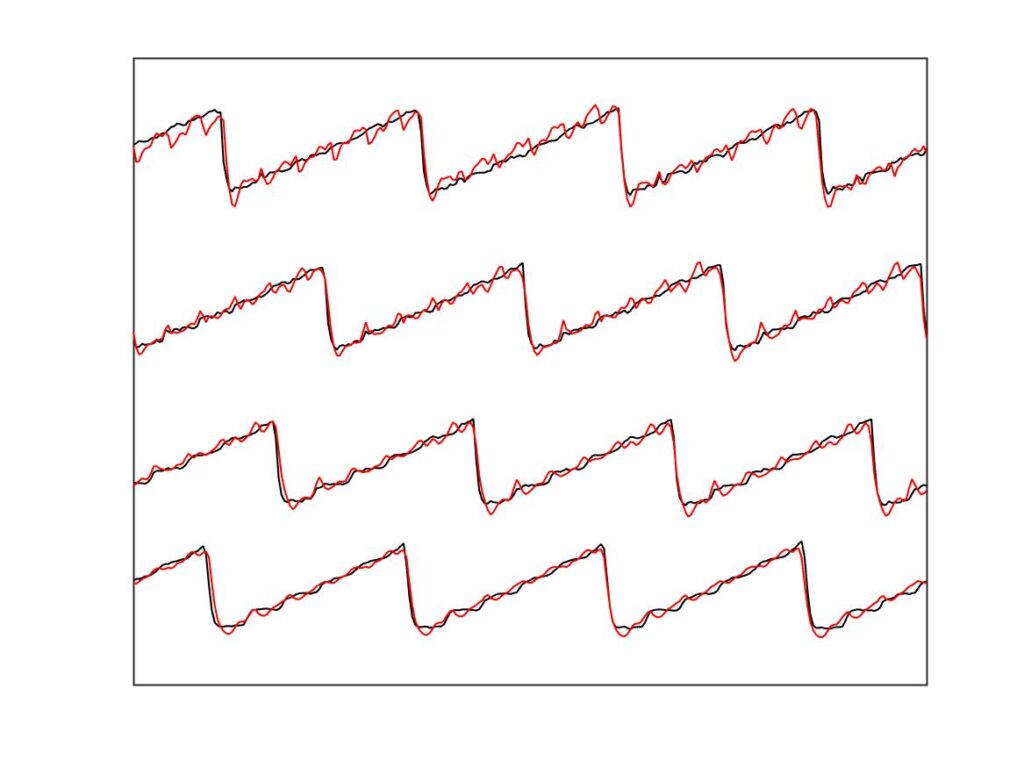
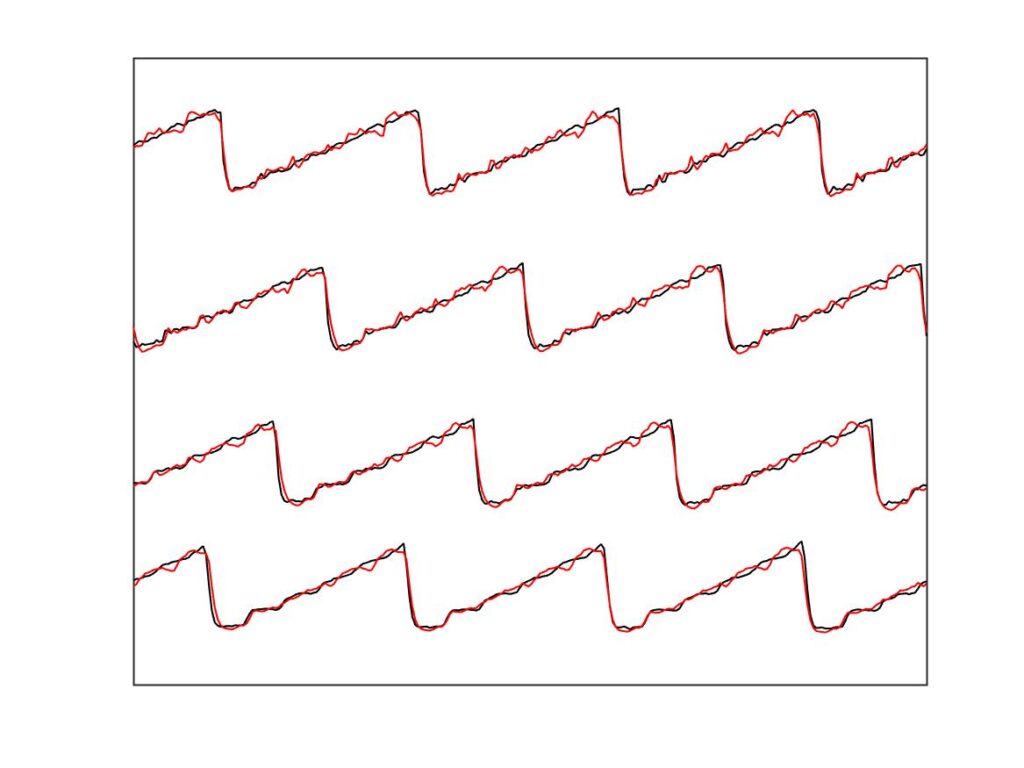
It is immediately clear that the finite-width simulations match the measurements much more closely than the point-bow simulations do. The contrast is most clear in Fig. 23, for the leftmost column of marked points in Figs. 20—22. For all four cases plotted, the point-bow simulation shows a “higher type” of one kind or another, whereas the measurement shows something close to the Helmholtz sawtooth. This is the second issue highlighted earlier: the enhanced thermal model seemed over-prone to higher types. With the finite-width simulations, on the right, the problem is substantially reduced: they show approximations to the sawtooth waveform in all four cases. The top two admittedly show a more marked pattern of “ripples” than the measurement, but nowhere near as prominent and disruptive as in the corresponding cases on the left.
The conclusion, backed up by inspecting a wider range of points in the Guettler diagram, echoes something we found in the Schelleng diagram. Finite bow width tends to suppress oscillations which in extreme cases turn into undesirable higher types, and now we can see that it does so in a way that seems to mirror measurements with a real bow fairly closely. In consequence, finite-width simulations based on the enhanced thermal model of friction seem able to give a reasonable match to all the available measurements of Guettler transients. The match is by no means perfect, but it is by far the best so far achieved. More plots relating to Guettler transients with this model, including some comparisons between the original and enhanced thermal models, can be found in the previous side link.
We have commented already that Fig. 22 shows transient lengths that are usually a bit too long. A particularly striking example is given by the second waveform from the bottom in Fig. 24. The corresponding marker in Fig. 22 shows up as a black square, but Fig. 24 shows a Helmholtz sawtooth. The explanation is simply that this case did lead, eventually, to Helmholtz motion, but the transient was more than 25 periods long so it was not caught by the processing that generated Fig. 22. The same description is true of the other black or dark brown pixels that form an obvious stripe across Fig. 22. No such feature is visible in Fig. 20, so this is an example of something not well captured by the simulation model.
Finally, Fig. 26 shows what the simulation model predicts with a tilted bow. The left-hand Guettler plot shows correct tilt, the right-hand one shows incorrect tilt. Comparing these with Fig. 22, we can see that correct tilt generates a lot more black pixels in the upper left of the plot. Incorrect tilt has a less striking effect, and if anything it increases the area of coloured pixels a little. However, note that all three plots show the wedge of brightest pixels in a very similar position. This corresponds, more or less, to Guettler’s original analysis of “perfect starts”, and it looks as if bow tilt has rather little influence on that region of the player’s parameter space. But if a player wants to create Helmholtz motion efficiently with rather high force but low acceleration, they had better use a flat bow rather than a “correctly” tilted one.
[1] R. Pitteroff and J. Woodhouse, “Mechanics of the contact area between a violin bow and a string. Part II: simulating the bowed string”; Acta Acustica united with Acustica, 84, 744—757 (1998).
[2] R. Pitteroff and J. Woodhouse, “Mechanics of the contact area between a violin bow and a string. Part III: parameter dependence”; Acta Acustica united with Acustica, 84, 929—946 (1998).
[3] Hossein Mansour, Jim Woodhouse and Gary P. Scavone, “Enhanced wave-based modelling of musical strings, Part 2 Bowed strings”; Acta Acustica united with Acustica, 102, 1094–1107 (2016).
[4] M. E. McIntyre, R. T. Schumacher and J. Woodhouse, “Aperiodicity in bowed-string motion”, Acustica 49, 13—32 (1981). See also Erratum, Acustica 50, 294—295 (1982).